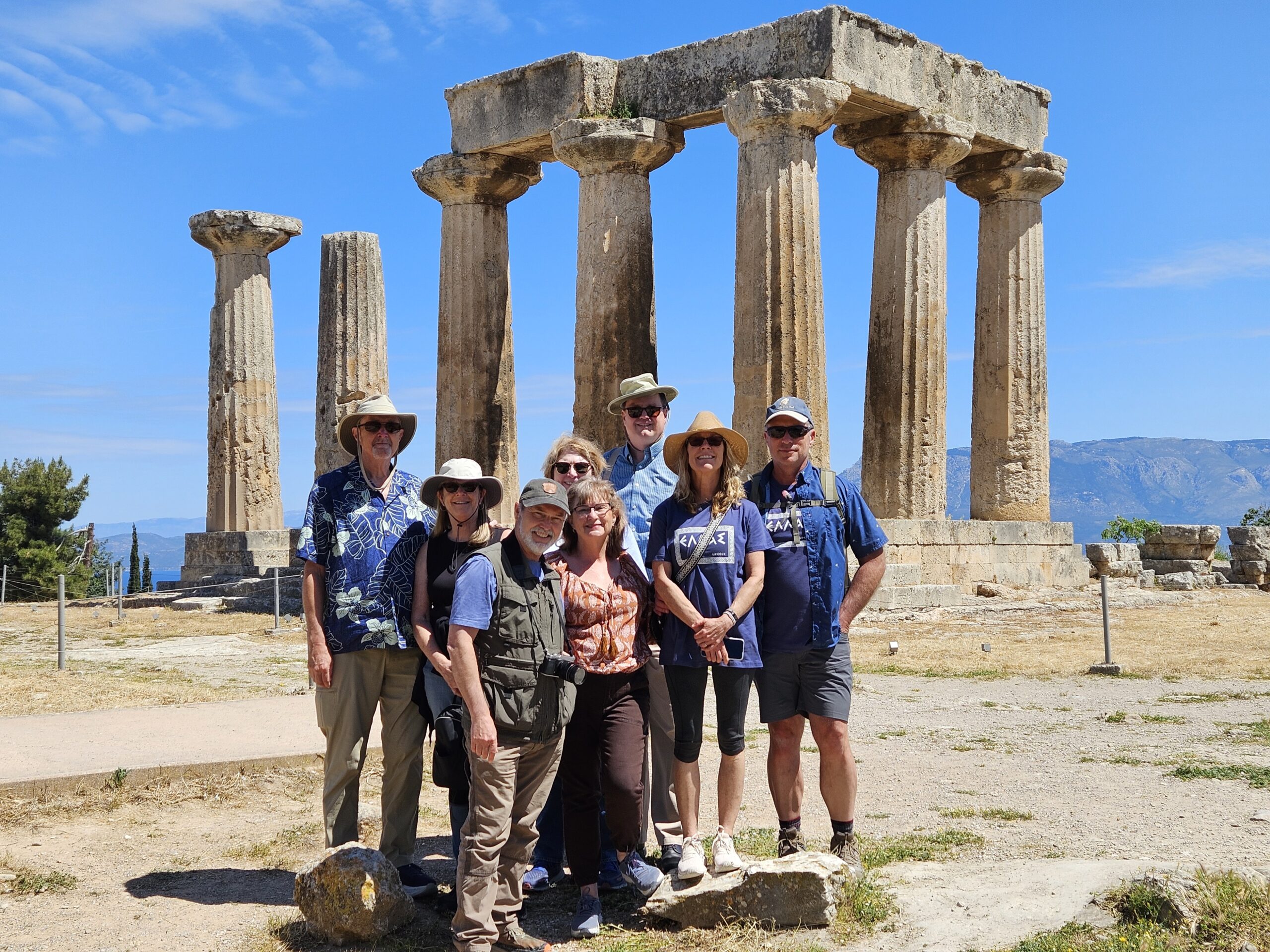
Visit the archaeological site and museum of ancient Corinth, known from two letters of St. Paul in the New Testament, and the places where St. Paul preached (Acts 18.1 – 18).
Visiting the Bema of the Apostle Paul (Acts 18:12-17). The place where Paul was tried before Gallio. A plaque with a biblical passage. The Agora (Forum) where Paul preached.
Meteora Monostaries – There were originally 24 monasteries built on the dramatic rock pillars of Meteora. Today, six monasteries remain active and open to visitors.
This guy was blowing his trumpet for Trump, he was a big fan.
Acropolis Hill – Areopagus Hill (Mars Hill). The Apostle St. Paul, who first introduced Christianity to the Athenians, preached here (Acts 17:22-31). With a Bronze plaque with Paul’s sermon, a view of the Acropolis and Athens.
Kalambaka, we will visit the Monasteries built on top of the Giant Rocks, which offer magnificent views of the Meteora region’s geography.
Meteora is a UNESCO World Heritage Site. In the 14th century, monks built monasteries on high, steep, and gigantic rocks in Meteora to seek an isolated place away from oppression and occupation. We will admire the old manuscripts, icons, colourful original frescoes, and unique mosaics in these churches, built on rocks, and gather information from the priests in charge. Access to these Meteora monasteries, most of which lacked stairs, was provided by a manual system utilizing a rope and pulley.
Delphi is a UNESCO World Heritage Site and one of Greece’s major archaeological sites. Δελφοί [ðelˈfi],in legend previously called Pytho (Πυθώ), was an ancient sacred place in central Greece. It was the seat of Pythia, the major oracle who was consulted about important decisions throughout the ancient classical world. The ancient greeks considered the centre of the world to be in Delphi, marked by the stone monument known as the Omphalos of Delphi. The term omphalos was the Greek word for “navel”. There are so many mythical stories about the oracle and the advice they gave.
This next church wasn’t on our list, but we were able to visit as it was on the way. The Daphni Monastery. The first monastery was erected on the site in the 6th century A.D. The interior of the church is decorated with superb mosaics, dating from the end of the 11th century, a unique, fine example of the Classical idealism of Middle Byzantine art. The crowded scenes of the mosaics narrate scenes from the life of Christ and the Virgin. The individual figures represent archangels, prophets, saints, martyrs, bishops.
Thessaloniki, where Paul preached the gospel on his second and third missionary journeys. He wrote letters known as “The First and Second Epistles to the Thessalonians” for the first Christians of this city. We see the White Tower, a symbol of Thessaloniki, the Church of Saint Demetrius, and the Church of St. Sofia.
Acts 17: 10 And the brethren immediately sent away Paul and Silas by night unto Berea: who coming thither went into the synagogue of the Jews. 11 These were more noble than those in Thessalonica, in that they received the word with all readiness of mind, and searched the scriptures daily, whether those things were so.
Vergina, the legendary burial place of Macedonian Kings. The tomb of King Philip II, the father of Alexander the Great, who significantly contributed to the development of Hellenism in Greek lands.
Philippi: The Apostle Paul visited Philippi around 49-50 AD and founded one of the first Christian communities in Europe there. His Letter to the Philippians in the New Testament is addressed to this community. Lydia, the first European convert to Christianity, was baptized near Philippi.
Veria (Berea), which Paul visited (Acts 17.10-14). On his visit to Veria town in AD 50, St. Paul encountered a more “noble” Jewish community. He also met his friend Sopatros on his return trip to Asia from his missionary trip, with whom he travelled together for a long time. We visited the ancient synagogue where Saint Paul preached
Alexandria Troas, Paul’s first recorded visit to Troas occurs during his second missionary journey. After traveling through the region of Phrygia and Galatia, Paul and his companions were “kept by the Holy Spirit from preaching the word in the province of Asia” (Acts 16:6). They then attempted to enter Bithynia, but “the Spirit of Jesus would not permit them” (Acts 16:7). Consequently, they traveled to Troas, where Paul received a vision of a man from Macedonia pleading, “Come over to Macedonia and help us” (Acts 16:9). This vision was a divine directive, prompting Paul and his companions to set sail for Macedonia, thus marking the beginning of the Gospel’s spread into Europe.
Alexandria Troas, Paul’s second visit to Troas is recorded during his third missionary journey. After spending time in Ephesus and traveling through Macedonia and Greece, Paul returned to Troas. Acts 20:6-12. During this visit, Paul engaged in an extended teaching session on the first day of the week, which continued until midnight. It was during this gathering that Eutychus, a young man, fell asleep and subsequently fell from a third-story window. Paul went down, embraced him, and declared, “Do not be alarmed, for his life is in him” (Acts 20:10). Eutychus was miraculously restored to life, and Paul continued speaking until daybreak before departing.
Paul walked here
Philippi: The Apostle Paul visited Philippi around 49-50 AD and founded one of the first Christian communities in Europe there. His Letter to the Philippians in the New Testament is addressed to this community. Lydia, the first European convert to Christianity, was baptized near Philippi.
Philippi, 13And on the sabbath we went out of the city by a river side, where prayer was wont to be made; and we sat down, and spake unto the women which resorted thither.
14And a certain woman named Lydia, a seller of purple, of the city of Thyatira, which worshipped God, heard us: whose heart the Lord opened, that she attended unto the things which were spoken of Paul. 15And when she was baptized, and her household, she besought us, saying, If ye have judged me to be faithful to the Lord, come into my house, and abide there. And she constrained us.
Church in PhilippiPaul would have walked hereChurch in Philippi
Philippi, In Acts 16:16-39 Paul and Silas in Prison. This is a story that serves to remind us that God does a sense of humor. 16 And it came to pass, as we went to prayer, a certain damsel possessed with a spirit of divination met us, which brought her masters much gain by soothsaying: 17 The same followed Paul and us, and cried, saying, These men are the servants of the most high God, which shew unto us the way of salvation. 18 And this did she many days. But Paul, being grieved, turned and said to the spirit, I command thee in the name of Jesus Christ to come out of her. And he came out the same hour.
19 And when her masters saw that the hope of their gains was gone, they caught Paul and Silas, and drew them into the marketplace unto the rulers, 20 And brought them to the magistrates, saying, These men, being Jews, do exceedingly trouble our city, 21 And teach customs, which are not lawful for us to receive, neither to observe, being Romans.
22 And the multitude rose up together against them: and the magistrates rent off their clothes, and commanded to beat them. 23 And when they had laid many stripes upon them, they cast them into prison, charging the jailor to keep them safely: 24 Who, having received such a charge, thrust them into the inner prison, and made their feet fast in the stocks.
The Conversion of the Jailer
25 And at midnight Paul and Silas prayed, and sang praises unto God: and the prisoners heard them. 26 And suddenly there was a great earthquake, so that the foundations of the prison were shaken: and immediately all the doors were opened, and every one’s bands were loosed. 27 And the keeper of the prison awaking out of his sleep, and seeing the prison doors open, he drew out his sword, and would have killed himself, supposing that the prisoners had been fled. 28 But Paul cried with a loud voice, saying, Do thyself no harm: for we are all here. 29 Then he called for a light, and sprang in, and came trembling, and fell down before Paul and Silas, 30 And brought them out, and said, Sirs, what must I do to be saved?
31 And they said, Believe on the Lord Jesus Christ, and thou shalt be saved, and thy house. 32 And they spake unto him the word of the Lord, and to all that were in his house. 33 And he took them the same hour of the night, and washed their stripes; and was baptized, he and all his, straightway. 34 And when he had brought them into his house, he set meat before them, and rejoiced, believing in God with all his house.
Pauls Prison in Philippi
Paul and Silas are Released
35 And when it was day, the magistrates sent the serjeants, saying, Let those men go. 36 And the keeper of the prison told this saying to Paul, The magistrates have sent to let you go: now therefore depart, and go in peace. 37 But Paul said unto them, They have beaten us openly uncondemned, being Romans, and have cast us into prison; and now do they thrust us out privily? nay verily; but let them come themselves and fetch us out. 38 And the serjeants told these words unto the magistrates: and they feared, when they heard that they were Romans. 39 And they came and besought them, and brought them out, and desired them to depart out of the city. 40 And they went out of the prison, and entered into the house of Lydia: and when they had seen the brethren, they comforted them, and departed.
Kavala, also known as the ancient city of Neapolis (Acts 16:11), was where Paul came with his disciples Silas and Timothy from Troas. Since Kavala was the first European city to adopt Christianity, it was named Hristoupolis.
Baptistry of Lydia – The Baptistery of Saint Lydia is a modern, octagonal Greek Orthodox church and open-air monument near ancient Philippi, Greece, marking the site where the Apostle Paul is believed to have baptized Lydia, the first Christian convert in Europe (Acts 16). Located on the Zygaktis River bank, it features mosaics and hosts baptisms. Built in 1974, it commemorates the first documented baptism on the European continent, occurring around 49-50 AD and is still used for baptism’s today.
The most prominent of the Seven Churches (Rev 2:1-7), praised for its works but rebuked for losing its first love. Paul spent ~3 years here (Acts 19), preached in the synagogue and hall of Tyrannus, and wrote Ephesians. It was a major center for early Christianity. Tradition holds that the Apostle John lived here, wrote his Gospel, and that he brought the Virgin Mary to the nearby house (John 19:26-27). The tour includes the well-preserved ruins, Library of Celsus, theater (where the riot over Artemis occurred in Acts 19), and St. John’s Basilica.
The Church of Ephesus is the most important of the Seven Churches of Asia Minor. It is thought that the Gospel of John was written. Paul was in Ephasus at least two times.
His First Visit (Second Journey): Paul briefly stopped in Ephesus with Priscilla and Aquila, preaching in the synagogue but staying for a limited time (Acts 18:19–21).
Second Visit (Third Journey): Paul returned to Ephesus for a total of nearly three years (over two years teaching in the school of Tyrannus, according to), making it a central hub for his ministry in Asia Minor (Acts 19).
Final Meeting: Paul later met with the Ephesian elders at Miletus on his way to Jerusalem, as he did not return to the city himself (Acts 20).
The House of the Virgin Mary is a small, modest stone house situated in the forest on the side of a mountain, approximately 9 km from Ephesus. St. John brought Mary to Ephesus, following Jesus Christ’s advice to his mother (John 19:27). And she spent her last years in this house.
The Temple of Artemis is one of the Seven Wonders of the Ancient World
St. John’s Church was built on the site of the tomb of Saint John by Byzantine Emperor Justinian and his wife, Theodora, in 565 A.D.
Turkish Rug Making Tour
We toured a Turkish Rug Making School sponsored by the Turkish Ministry of Education. We saw how they extract the silk from the moth cocoon to weaving and the special turkish knot using wool, cotton and silk.